
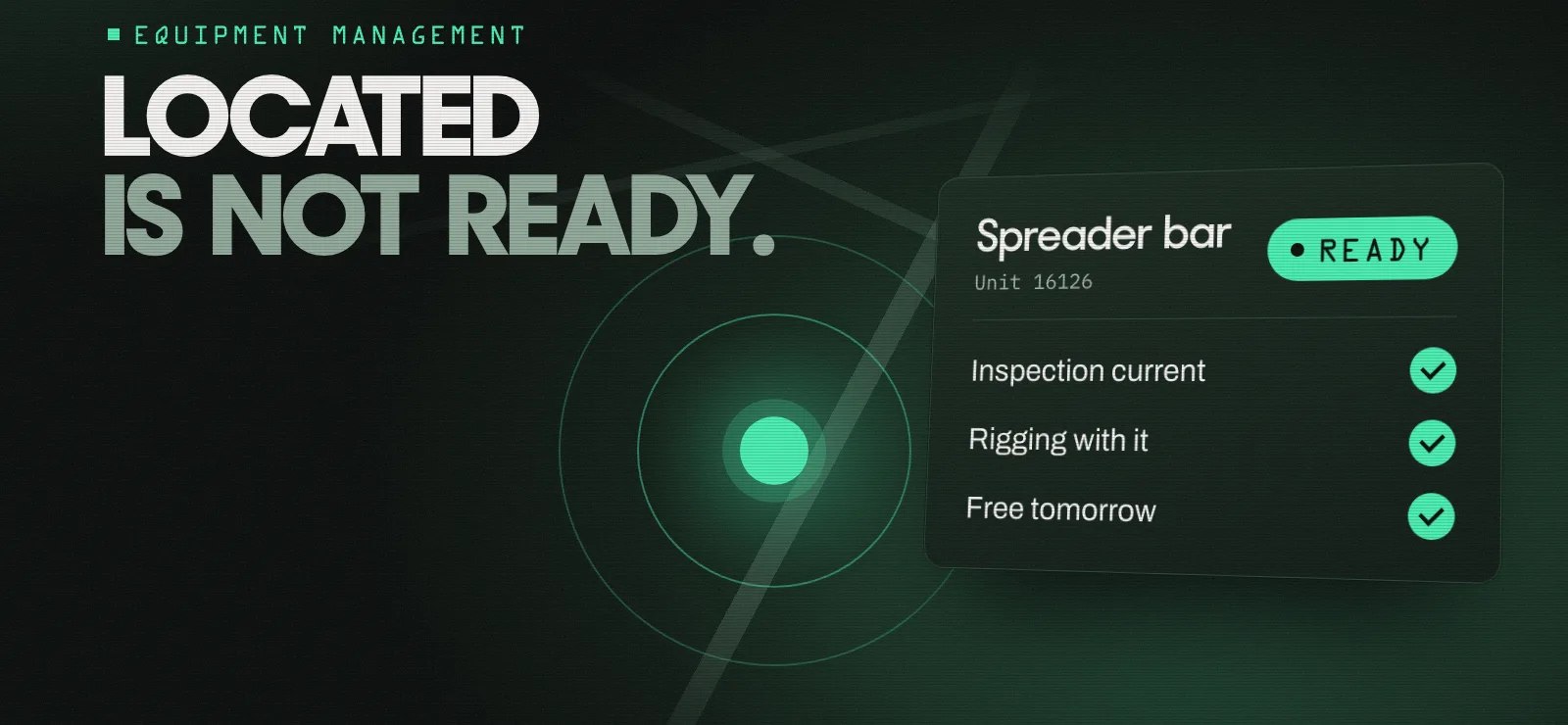
In the equipment-centric specialty trades, the equipment decides what the company can promise, so equipment management decides whether the job starts on time. Most of the software sold to these companies treats equipment management as tracking: a dot on a map, and the job is done. The dot answers one question. The job asks five more: is the machine free for the window, is it inspected and fit to go, are its documents current and with it, is the support gear it needs with it, and does the office know all of that before the truck leaves?
The industry has measured the gap. Labor productivity in construction grew about 1 percent a year over two decades against 2.8 percent for the world economy, a $1.6 trillion annual opportunity (McKinsey Global Institute, 2017). Closer to the yard, 74 percent of fleet operators name data accessibility as the largest barrier to improving equipment utilization, with assets frequently unused half the time, and 27 percent frequently rent or buy extra equipment to cover for unavailable assets (Teletrac Navman, 2026). A tool that only shows location leaves both figures where they are.
Beyond location: what the equipment record has to hold
Equipment management in these trades runs through every role: the estimator who quotes the machine, the dispatcher who commits it, the operator who runs it, the safety manager who checks its paper, and the billing clerk who invoices it. Ribbiot holds every asset the company owns, rents, or stages on one record, tracked or not, with its photos, documents, capacities, certifications, and status. Knowing where the machine is comes with knowing what it is allowed to do, whether it is free, and which job, crew, and support gear it is committed to.
Every machine and every piece of support gear carries five questions:
- Availability: is it free for the window, or already committed to another job?
Readiness: is it inspected, serviced, and fit to go?
Documents: are the inspection, the certification, and the machine's documents current and with it?
The job: is it on the right job, with the crew, the support gear, and the permits the job requires?
Visibility: can dispatch and the office see all of that before the truck leaves, and the same day when it changes?
Why a dot on the map falls short
A tracking tool says the machine is at the job site. It does not say whether the annual inspection is current, whether the operator assigned to it holds the certification the job needs, whether the support gear the job depends on is with it, or whether dispatch has already committed it tomorrow. Whatever the machine, the blind spots are the same. As Ribbiot’s founder Joe Frigo puts it, those gaps are the fog of operations: decisions made without clear, current, connected operational truth. Ribbiot was built to remove that fog with one record: the equipment, the people, and the job held together, so whether a machine can work is answered at planning instead of at the gate.
What equipment uncertainty costs
The company rents a piece of gear it already owns because nobody can confirm which yard it sits in. A job stalls at the gate because the annual inspection certificate is in a binder in someone else's truck. A machine sits on a finished job for days because nobody told the office the job ended. The industry measures the same symptoms at scale: 67 percent of fleet operators report assets held on site but unused because of maintenance and scheduling uncertainty, and 27 percent frequently rent or purchase extra equipment to cover for unavailable assets (Teletrac Navman, 2026).
When the location lives in one tool, the inspection in a binder, and the schedule on a whiteboard, the dispatcher, the equipment manager, and the office each hold a different piece of the truth at a different age. Operations managers who come to Ribbiot from a tracking tool bring the same two complaints: the phone calls to find out what the dot could not tell them, and the hours spent rebuilding what happened. On one record, the machine's location, its documents, its status, and the job it is committed to are the same answer for all of them.
What one record does for people, process, and equipment
1. Readiness: what the company can field
Every asset the company owns, rents, or stages sits on one record, tracked or not: machines, trucks, trailers, attachments, and support gear, each with its photos, documents, capacities, certifications, and status. The schedule is built from that record, so each asset's availability shows against every job on the board, across branches, and the double-booking is caught at planning instead of at the gate. Arsenal is the equipment record; Command is the board.
- Example: dispatch builds tomorrow from what the record shows as free and inspected, with the documents the job requires attached before the first resource moves, so a conflict or a missing inspection shows on the board while there is still time to fix it.
2. Compliance on the record, where the machine stands
The documents the work requires to be current, shift, monthly, and annual inspections, capacities, and support gear inspections, live on the asset's record, and a tap on the asset opens them on a phone at the equipment, so a job is not held waiting on paperwork that exists. Inspections and job safety analyses are submitted from the site against the work order the day they happen, and Ribbiot reads each one as it lands and surfaces the finding while the job is still running. Maintenance scheduling and return to service, Rearm, is in build.
- Statistics: the Occupational Safety and Health Administration's maximum civil penalty is $16,550 per serious violation and $165,514 per willful or repeated violation (OSHA, 2025 and 2026), and more than 425,000 certifications have been issued across 29 designations, each valid for five years and each a document with an expiration date that has to be where the work is (National Commission for the Certification of Crane Operators, 2025 and 2026).
3. Visibility: the plan carried over from the quote, the field written back the same day
A tracking tool is static: it shows a location and a timestamp. Ribbiot reads the record the job runs on. An accepted quote becomes the plan automatically. Command Intel adds planned resources for the crew and equipment the work requires, and sales or project management confirms them before the job goes to dispatch: Ribbiot fills in the first draft, and you check it. While the job runs, the ticket, the timecard, and the inspection come back from the site against the work order the day the work happens, and Track confirms where the equipment is, so a change in the field is visible against the plan.
- Example: a machine committed to two jobs in the same window shows as a conflict on the board at planning, while there is still time to move a job or a machine, instead of at the gate the morning of the job.
4. Clarity: the equipment on the invoice, on one record across every branch
Because the machine's hours and the signed ticket land on the same job as the quote, the invoice is built from what was performed, and margin is visible per job and per asset while the decisions that set it are still in reach. Ribbiot runs on top of the accounting system and feeds it, so nothing is ripped out: an accounting connection and the telematics connections are live today, and the devices a fleet already runs come into the equipment record as a connection. No hardware is required to be a Ribbiot customer. The record spans branches and divisions, so a company with several locations runs one fleet, one workforce, and one truth across all of them.
Why the tools built for other work fall short here
Most of these companies have bought software before and still run on paper, whiteboards, spreadsheets, and a client-server tool the industry has used for decades. The patterns repeat. A telematics tool knows where some of the machines are and nothing about the job, the crew, the documents, or the invoice the machine supports. A process-only system improves an office workflow without ever holding the equipment truth that decides whether the job is ready. Software built for repeatable work fits a truck that rolls out the same way every day; a job that is engineered every time does not fit its template. Ribbiot is different on two counts:
- Built for this work: Ribbiot is purpose-built for equipment-centric specialty trades, where every job is a configuration of equipment, support gear, crew, certifications, permits, and site conditions, and a change to any one of them re-decides the rest. The record is built around that configuration and re-checks it every time a variable moves.
Forms crews already know: tickets, timecards, inspections, and job safety analyses are configurable and built to look like the paper they replace, submitted from the site against the work order, so the field keeps its way of working and the office gets the record the same day.
Where this leads
Ribbiot's mission is to simplify the complexities of physical operations to deliver visibility and foster sustainable growth. The fog of operations is what stands in the way. Ribbiot is the operational layer that runs on top of a company's accounting system, carrying the full operational story from quoting through invoicing across people, process, and equipment, and the equipment record is what every stage of that story reads.
None of this asks a company to replace its accounting system or to take the whole platform at once. Companies land on the pain that hurts most, the equipment record, a forms workflow, or quoting, and add the next workflow when the first has earned its keep. What they get: readiness before the job starts, visibility while it runs, clarity when it closes.
Bring one job to a 60-minute discovery call. We walk it with you from the quote to the invoice and show what one record changes at each handoff, starting with the equipment. Walk one job