
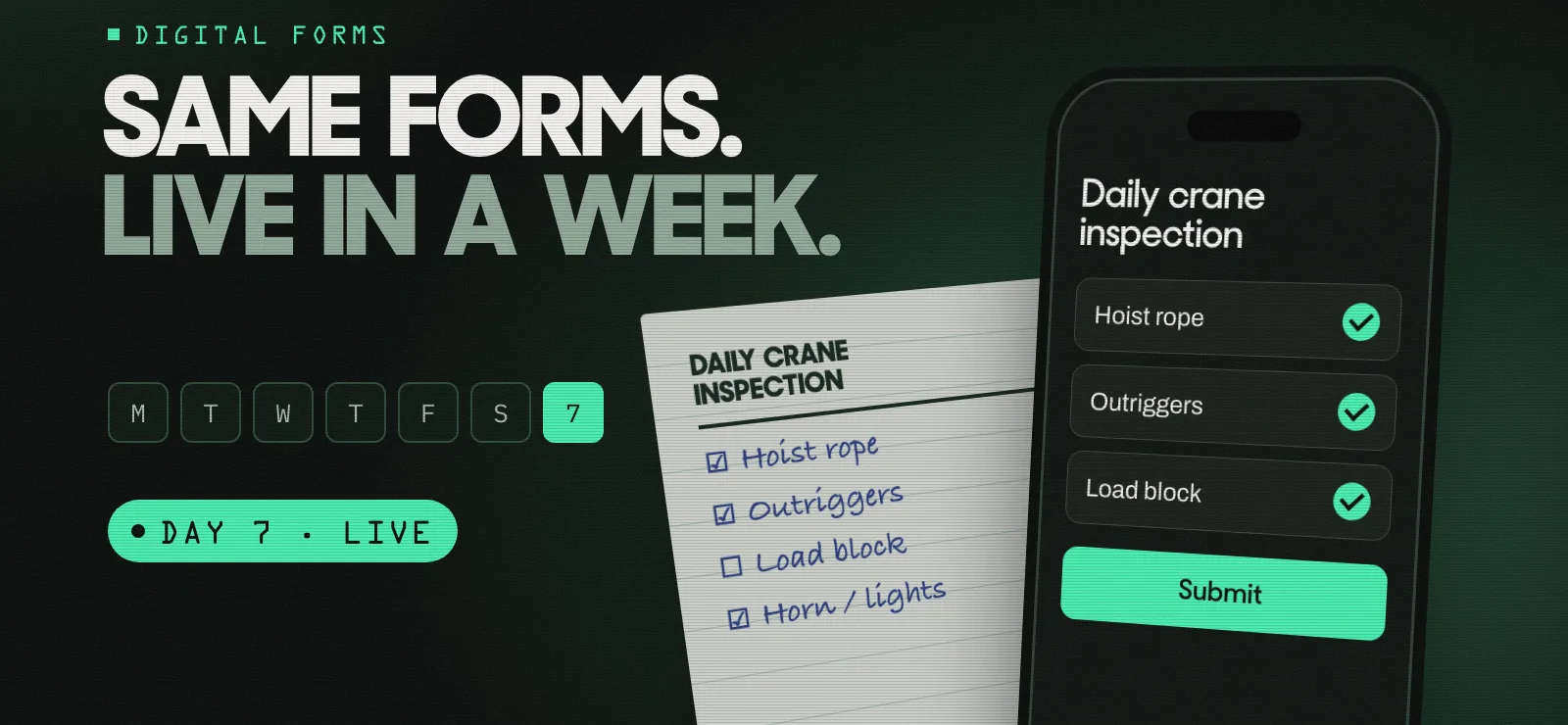
The problem: long rollouts burn out the field before go-live
In the equipment-centric specialty trades, software rollouts have run long, expensive, and painful. Companies spend months preparing, book Saturday training with the union reps, run makeup sessions for the crews that missed it, and write reference guides. By the time the system goes live the field is worn out, and adoption often fails.
The money at stake is large. United States contractors lost about $30 billion to $40 billion to labor inefficiencies in 2022 (FMI, 2023), and construction labor productivity grew about 1 percent a year over the two decades to 2017, against 2.8 percent for the world economy and 3.6 percent for manufacturing (McKinsey Global Institute, 2017).
Paper makes it worse. The ticket rides back in the truck, so billing waits for it. The timecard is read off handwriting on Monday, so payroll gets rebuilt. The inspection stays in the cab, so the record is missing on the day someone asks for it.
Why software has been harder to adopt in construction
If software has felt harder to adopt in your industry than in others, you are right. McKinsey Global Institute's digitization index, published in Harvard Business Review, ranked United States industries by digital adoption and put construction second to last, ahead of only agriculture (McKinsey Global Institute, in Harvard Business Review, 2016).
The leadership was never the problem. The tools were: complex, rigid, and built for someone else's work, so every rollout asked a crew to learn a system that looked nothing like its day. The field pushed back, and the pushback cost money and goodwill.
That is why Ribbiot starts with the forms your crews already know. The timecard, the ticket and the inspection go onto the phone looking like the paper they replace, filled in against the job, and the office sees them the same day. It is the fastest start Ribbiot runs, and the first value usually shows in the office within about a month of go-live.
How one crane company started
One union crane service company had found software rollouts close to impossible. Crews resisted new systems, and the union hall pushed back on disruptions. Every earlier rollout had meant paid training on a Saturday and a backlash on Monday.
Ribbiot put the exact paper forms the crews already used on the phone, with the right prompt on each field, so they took less time to fill in than the paper had. Nothing felt new. The forms were live in the first location within weeks, and the changes since have been a few added fields, at the company's own pace.
What changes first
Paper gone: the first return
Removing paper is the first thing the office notices. The carbon-copy books stop being ordered, the stacks stop being filed and chased, and the ticket that fell behind the seat stops costing the job its billing.
What compounds once the paper is gone
Once the field record can be trusted, the value shows up in several places at once:
- No more lost tickets and no more messy handwriting slowing down payroll or billing.
- The office sees what happened on the job the same day, and the inspection, the ticket and the signature sit on the job record when a customer, an auditor or an insurer asks for them.
- Invoices go out from the signed ticket and the approved time instead of waiting for the paper to come back, so the money comes home while the crew is still nearby.
- Crew buy-in, because operators fill in the same forms they always have, on a phone instead of a clipboard.
- A clean ticket and a legible invoice reach the customer instead of a faded carbon copy, and the general contractors and industrial owners you work for are already running digital accounts-payable desks, so a digital ticket processes faster at their end too.
The gains compound, because the fog is a death by a thousand cuts: one fix slows the loss in several places at once. A forms-first start buys visibility while the work runs, one of the three outcomes Ribbiot is built around, beside readiness before the job starts and clarity when it closes.
The industry's own numbers say how much the paper costs. Construction professionals spend 5.5 hours a week looking for project data and 14.1 hours a week, 35 percent of their time, on non-optimal activity: looking for information, resolving conflicts, and dealing with mistakes and rework (PlanGrid and FMI, 2018). Poor data and miscommunication cause 52 percent of rework worldwide (PlanGrid and FMI, 2018).
Why a forms-first start sticks
- Capture puts the forms your crews already know on the phone, against the job, so the field fills in what it always has.
- A single workflow typically goes live in about four to five weeks, and the first value from a forms-first start usually shows in the office within about a month of go-live.
- The next workflow follows when the record has earned it: the board that gives the forms their plan, then billing from the signed ticket. Nothing is added before you ask for it.
- Software built for repeatable work makes the crew learn its forms and sit through the retraining, and the return waits on both.
The customers these trades serve have already gone digital. The general contractors and industrial owners are running digital accounts-payable and compliance desks, and a customer who has processed a digital ticket does not want paper back. Companies that start on the forms get the field record first, and everything after it builds on that.
Where to start
Pick one job where the paper came back late. In a 60-minute discovery call we walk that job from the quote to the invoice and see whether a forms-first start fits. Walk one job