
The Monday after the training
On Saturday the company ran a town-hall training on its new payroll system, the one meant to retire the paper timecards. By Monday morning the office is already hearing about it:
- Payroll: glad to see less paper, worried about what the new entries will do to the pay run.
- The tech lead: worried about the gaps in the system and the clean-up that follows them.
- Operations: doubtful the crews will take to it, and wary of how many steps it adds.
- The crews: frustrated, and already working around it.
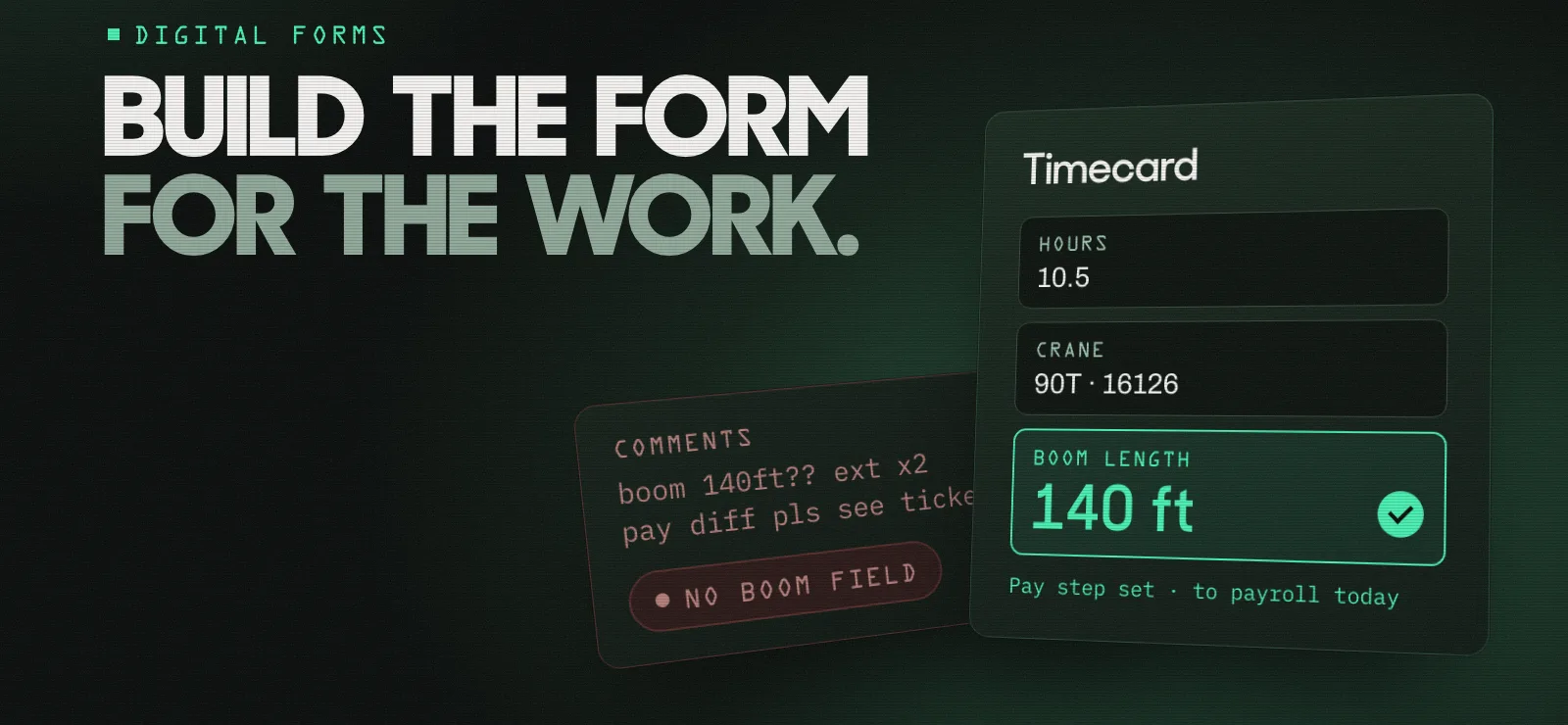
The new system has no field for boom length. Under the crews' collective bargaining agreement, an operator's pay steps up with the length of boom on the crane, so that one number decides the paycheck. The workaround on offer: type it into the comments box.
By Wednesday:
- The veteran operators stop trusting the form, because a missed line in the comments box is a short paycheck.
- The crew members who know their way around an app try to force the number into fields built for something else.
- The union hall starts getting calls about the system and the workarounds it needs.
No training session fixes a form that has no field for the thing the crew gets paid on. Once the form forces a workaround, the record goes wrong at the source, and the crew stops trusting it.
What a form that fights the crew costs
Labor is the largest cost these companies control. It is also the one they are shortest of. Improving labor productivity by 6 to 10 percent is worth 2 to 3 percent on the bottom line (FMI, 2023), and a form that fights the crew moves it the other way. The industry needs to attract an estimated 349,000 net new workers in 2026 and 456,000 in 2027, with most of the 2026 need driven by retirement (Associated Builders and Contractors, January 2026). A form that fights the crew spends the scarcest people the company has on fighting the form.
Where it lands:
- Missing field truth. The minutes a crew spends fighting the form come out of the work, and what reaches the office is late, incomplete, or in the wrong box.
- Admin drag. Payroll rebuilds the week from the comments box, the corrections pile up, and a premium nobody can trace becomes the call from the union hall.
- Idle crews, and the ones who leave. Operators rarely quit over pay alone; they quit over Mondays where the plan is wrong, the equipment is missing, and the paperwork boomerangs back. In a market short of certified operators, a form that fights the crew gets paid for in resignations.
The same form, built to fit the work
Run the same Monday on Ribbiot. The timecard looks like the one the crews already know. It opens against the work order, with the job's context already there. And it carries the fields the company's pay rules need, boom length included, because the form is configured to the company instead of the company to the form. The module is Capture, Ribbiot's forms and timecards.
What changes for the people in the story:
- For the operator: the field the pay rule needs is on the form, whether that is boom length, a job code, or a premium the agreement sets, so the number goes where payroll reads it.
- For payroll: nothing rides in the comments box, so the week arrives approved against the work order instead of rebuilt from notes, and the payroll provider stays.
- For the crew: the right form opens against the work order with the right prompts, built to tolerate the signal the field actually has, and the crew fills in what happened and nothing else.
- For the safety manager and the office: timecards, tickets, inspections, job safety analyses, authorizations, and job packets all submit from the job site against the same work order, so one record holds the day.
- For billing: the ticket, the timecard, and the inspection reach the record the same day, readable and attached to the job, so the invoice goes out from what the field signed instead of what the office could decipher.
Where to start
The crews are the scarcest people the company has. A form they fill every day has to be built around how they work: on the site, between tasks, with gloves on. Fix that one form and the week changes at both ends: the crew stops fighting the form, and payroll stops rebuilding the week from the comments box. The same goes for the ticket a crew signs at the end of the day and the job safety analysis it fills before the work starts.
Bring that form to a 60-minute discovery call. We walk through where its data goes missing between the field and payroll, and what the same form looks like on one record. Walk one job